
Starting in trading means measuring the gap between what online promotions promise and what real accounts produce. According to the AMF, the vast majority of retail traders lose money on leveraged products. Since law n° 2023-451 of June 9, 2023, the promotion of leveraged CFDs and forex by influencers is banned in France, indicating that the regulatory framework is tightening to protect beginners.
The seven steps below cover the concrete fundamentals for structuring your first investments without burning your capital.
1. Check the regulatory status of the broker before registering

The first reflex before opening an account is not to compare fees, but to ensure that the broker is listed on the AMF register or a recognized European regulator. The AMF’s blacklist lists reported platforms. In 2024, the DGCCRF ordered ten influencers to cease promoting a platform listed on the blacklist, proving that unregulated actors remain active.
A regulated broker in the European Union applies the leverage limits set by the ESMA (maximum 30:1 on major currency pairs for retail clients). This constraint protects the beginner’s capital much more effectively than a poorly placed stop-loss. Any platform offering leverage above these thresholds without professional qualification of the client is likely operating outside the legal framework.
Before following the recommendations of a trainer or trading coach, it is useful to cross-check their advice with Gagnez Net guides that detail each verification step for a beginner.
2. Define a trading budget separate from other savings

The capital allocated to trading should be an amount whose total loss does not affect daily life or financial plans. This is not generic caution advice: it is the condition for maintaining psychological stability after a series of losses, which will happen.
The table below compares two capitalization approaches for a beginner.
| Approach | Capital engaged | Risk per position | Estimated learning duration |
|---|---|---|---|
| Leisure budget (limited risk account) | Several hundred euros | 1 to 2 % of capital | 6 to 12 months on simulator then real |
| Significant capital without prior training | Several thousand euros | Often above 5 % | Frequent losses from the first weeks |
The first approach limits damage and forces adherence to a process. The second reproduces the statistical pattern that explains why the majority of retail accounts are in deficit.
3. Use a trading simulator before committing real capital

A demo account replicates market conditions without financial risk. Most regulated brokers (eToro, XTB, IG) offer a free simulator with real-time data. The goal is not to generate fictitious gains but to master three mechanisms: order placement, automatic margin calculation, and stop-loss functioning.
Staying on the simulator for at least several weeks allows you to identify your behavioral biases (over-trading, refusal to cut a loss) without financial consequences. Going live too early remains the primary cause of abandonment among beginners.
4. Choose a single market and a single strategy at the start

Stocks, forex, CFDs on indices, commodities: the diversity of accessible markets pushes beginners to scatter their attention. In reality, focusing on a single instrument for several months develops a finer reading of price movements than a superficial glance at five different markets.
The choice of market depends on available time. Forex operates continuously five days a week, which suits those who trade in the evening. European stocks impose fixed time slots (opening and closing sessions) but often offer more readable volatility for a beginner.
On the strategy side, technical analysis with simple indicators (moving averages, support and resistance) remains the most documented entry point. Multiplying methods at the start dilutes learning.
5. Apply a fixed risk/reward ratio on each position
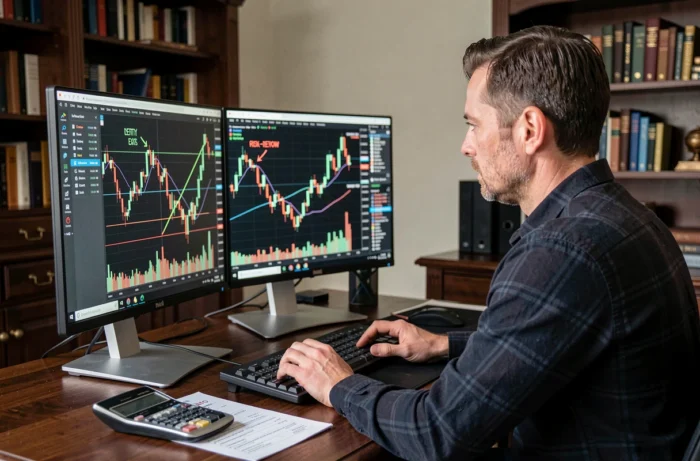
Risk management is measured position by position. A risk/reward ratio of 1:2 means that the targeted gain is twice the accepted loss. This ratio, applied systematically, allows you to remain profitable even with a success rate below 50 %.
The elements to set before each order:
- The stop-loss level, calculated as a percentage of total capital (generally 1 to 2 % for a beginner)
- The take-profit level, consistent with the chosen ratio
- The position size, adjusted so that the maximum loss respects the budget per trade
Never move a stop-loss in the direction of the loss is the hardest rule to follow, and the one that separates sustainable accounts from liquidated ones.
6. Keep a trading journal from the first operation

A trading journal records each position: instrument, direction (buy or sell), entry time, exit time, result, and especially the reason for taking the position. Without this tracking, it is impossible to distinguish a gain related to the method from a gain related to luck.
After documenting about thirty trades, recurring patterns emerge:
- The time slots where decisions are most reliable
- The chart setups that produce the best success rate
- The moments when emotion (impatience, revenge after a loss) triggers mistakes
The journal transforms intuition into actionable data. It is the tool that distinguishes a structured learning process from a disguised game of chance.
7. Understand the taxation of capital gains before withdrawing your profits

In France, capital gains on financial instruments are subject to the flat tax or, optionally, the progressive income tax scale. The choice between these two regimes depends on the taxpayer’s overall income and can significantly affect net returns.
Realized losses can be offset against gains of the same nature for ten years. A beginner who finishes their first year at a loss should therefore declare their capital losses to reduce the taxable base in subsequent years. Ignoring this mechanism means paying more taxes than required when gains arrive.
The tax framework also applies to CFDs and forex, contrary to a common misconception among beginners. Not every withdrawal triggers taxation: it is the annual balance of gains and losses that matters.
The European regulation continues to evolve on derivative products intended for individuals, and the ESMA continues its periodic reviews of protective measures. Structuring your first investments around these seven steps mechanically reduces exposure to the most costly mistakes, those that occur even before learning to read a chart.