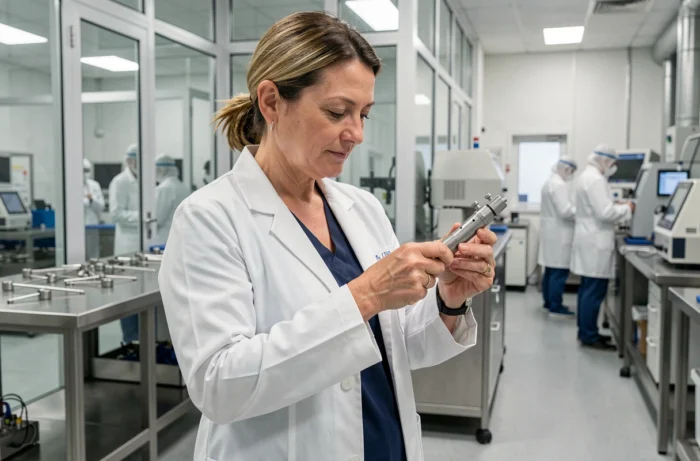
When a hospital orders a scanner, a splint, or a simple blood pressure monitor, the delivered product rarely comes from a single factory. Behind every medical device lies a dense industrial fabric, shared between multinationals based in France and specialized SMEs in niche markets. The landscape of medical equipment manufacturers in France reveals a sector where geographical concentration and specialization by segment dictate the balance of power.
In vitro diagnostics and imaging: the segments where France truly produces
Not all manufacturers produce the same things. In France, the strongest sub-segments remain in vitro diagnostics, orthopedics, medical compression, and medical textiles. Several historical production sites exist in these fields across the territory.
Let’s take a concrete example. bioMérieux, based in Marcy-l’Étoile near Lyon, designs and manufactures microbiological diagnostic automation used in laboratories worldwide. It is not just a simple assembler: R&D, production, and logistics are integrated on French soil.
In imaging, SuperSonic Imagine (now part of Hologic) developed internationally recognized ultrafast ultrasound technology in Aix-en-Provence. These players illustrate a point often misunderstood: French manufacturers occupy high value-added niches, not the mass production of generic equipment.
The medical equipment manufacturers in France thus cover a much broader spectrum than the general public imagines, from laboratory reagents to implantable devices.
Multinationals based in France and specialized SMEs: two industrial logics
Have you noticed that the names that keep coming up in French hospitals are often American or German brands? Stryker, Medtronic, Johnson & Johnson, B. Braun: these global groups have industrial sites, R&D centers, or logistics platforms in France. Their presence is not limited to a sales office.
Multinationals dominate high-tech equipment (implants, prosthetics, assisted surgery devices). The investments required for certification, clinical trials, and production infrastructure exceed the capabilities of most SMEs.
Domestic players, on the other hand, position themselves differently. Thuasne manufactures orthoses and textile support devices from Saint-Étienne. Sigvaris produces medical compression stockings. Urgo develops technical dressings. These French SMEs and mid-sized companies rely on very targeted expertise, often inherited from decades of local industrial practice.
What this duality means for healthcare facilities
A hospital equipping an operating room almost systematically turns to a multinational for heavy devices (tables, surgical lights, monitors). For consumables, medical textiles, or common orthopedic devices, mid-sized French manufacturers remain competitive.
This distribution is not a coincidence. It reflects the very structure of the market: according to SNITEM, the sector comprises around 1,500 companies in France, the vast majority of which are SMEs and mid-sized companies.
Geographical concentration of medical equipment: Auvergne-Rhône-Alpes in the lead
The production of medical devices in France is not evenly distributed. Two regions concentrate the majority of activity: Auvergne-Rhône-Alpes and Île-de-France.
Around Lyon, Saint-Étienne, and Grenoble, the MedTech cluster is the largest in France. Here you can find bioMérieux, Thuasne, Stryker, and start-ups in connected devices. The Lyonbiopôle hub structures this regional sector.
In Île-de-France, the logic is different. Headquarters, R&D centers, and some biotech platforms are concentrated there. Hologic France and Air Liquide Healthcare are present, but actual industrial production is less dense.
- Auvergne-Rhône-Alpes: production, R&D, and logistics around Lyon, Saint-Étienne, and Grenoble, with the Lyonbiopôle hub
- Île-de-France: headquarters, research, biotech (Medicen Paris Region, Saclay plateau)
- Provence-Alpes-Côte d’Azur: medical imaging and diagnostics (Aix-en-Provence, Sophia Antipolis) via the Eurobiomed hub
- Hauts-de-France: blood transfusion and health devices (Maco Pharma in Mouvaux, Eurasanté hub in Lille)
Certifications and CE marking: the filter that structures the sector
Why are there so few new entrants in medical equipment manufacturing? The answer largely lies in regulatory requirements. Every medical device sold in Europe must bear the CE marking, which certifies its compliance with safety and performance standards.
To obtain this marking, a manufacturer must implement a quality management system compliant with ISO 13485. Audits are conducted by notified bodies, and the process can take several months, or even more than a year for the most complex devices.
This regulatory framework mechanically favors already established companies. An SME manufacturing a new type of connected dressing must mobilize the same documentary and clinical resources as a large group, with a much smaller budget. Certification acts as a barrier to entry that explains the stability of the French industrial landscape.
Class I, IIa, IIb, III devices: different paths
A stethoscope (class I) does not follow the same regulatory path as a hip prosthesis (class III). The higher the risk to the patient, the more stringent the requirements for clinical evidence and traceability become.
- Class I (low risk): self-certification possible by the manufacturer for most devices
- Class IIa and IIb (moderate risk): mandatory intervention by a notified body, detailed technical file
- Class III (high risk): complete clinical evaluation, enhanced post-market surveillance
This classification also explains why French SMEs more often position themselves in classes I and IIa, where market access costs remain compatible with their size.
The landscape of medical equipment manufacturers in France can ultimately be understood through three lenses: specialization by segment, industrial geography, and the weight of regulation. These three factors, combined, shape a sector where positions shift slowly, but where each well-occupied niche can prove sustainable.