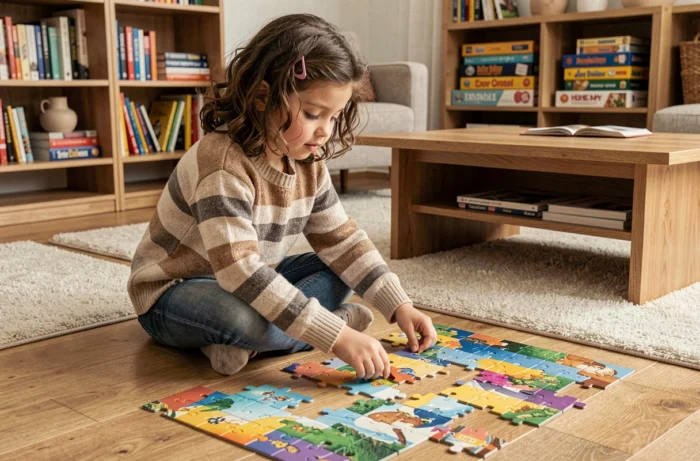
Toy aisles and online catalogues offer thousands of products, but choosing a game for home use depends on criteria that aren’t always mentioned on the packaging. The age listed on the box is a basic guideline, not a complete guide.
European regulations also require warnings to specify, where necessary, usage restrictions and the need for adult supervision. So, choosing the best games and activities to keep children entertained at home means weighing several factors before even considering the type of game.
Toy safety at home: what the CE marking doesn’t tell you
The CE marking appears on almost all toys sold in Europe. Many parents see it as a sign of quality control. In reality, the CE marking is a declaration by the manufacturer, not an independent certification. The product has not necessarily been tested by an external body before going on sale.
For home use, this distinction has practical implications. It’s worth checking the manufacturer’s identity, the age warnings printed on the packaging and the product’s overall condition. Extra care is needed with second-hand toys: missing parts, exposed screws or chipped paint can change the level of risk, regardless of the original marking.
European toy safety regulations are evolving, with revisions underway that will tighten certain requirements. A rule adopted at European level does not necessarily apply to toys currently on sale. It’s therefore better to rely on the product’s specific warnings rather than the CE logo alone when choosing a game for everyday indoor use.
Parents looking for games and toys suited to different age groups can browse specialist catalogues such as kids-paradise.fr, which feature products organised by age, along with detailed specifications.
Games for children by age: match your choice to their actual abilities
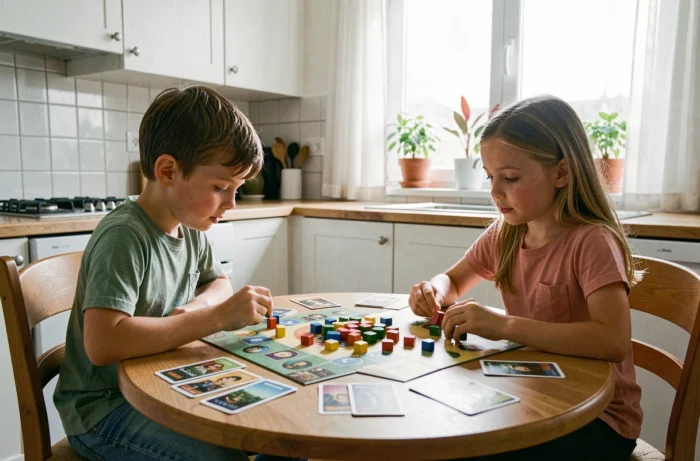
The age listed on a toy indicates a safety threshold, not a threshold for enjoyment. A four-year-old may get bored with a game designed for their age group if they have already developed certain motor or cognitive skills. Conversely, a child of the same age may struggle with a game recommended for ages three and up.
What matters beyond the age range
- The child’s actual fine motor skills: can they handle small pieces, stack objects or screw things together? A construction set that’s too complex may be abandoned within minutes, while a game slightly below their level can provide a starting point for their own variations
- Their attention span: a board game with five-minute turns is a better fit for a child who loses focus quickly than a strategy game designed for 30-minute sessions
- The play setting: a child playing alone has different needs from one playing with an adult or a sibling. The level of supervision required also varies depending on the pieces involved and the space available
A game suited to a child’s actual abilities will keep them occupied longer than one chosen solely by age. Watching how the child behaves during the first few minutes of play provides more reliable feedback than any information on the packaging.
At-home activities with minimal supplies: turn the kitchen and living room into a playground
The most lasting activities at home don’t require expensive supplies. The kitchen and living room offer plenty of opportunities for sensory, creative and physical play, as long as you plan the activity in advance.
Sensory activities using everyday items
Sensory bins filled with rice, pasta, lentils or couscous in a large container let children explore a variety of textures. This type of activity works for children from age two with supervision, and remains popular until age five or six when you add objects to sort or bury.
Sensory activities develop fine motor skills without requiring any extra purchases. A mixing bowl, a few cups and some dry food are all you need for a 20- to 30-minute activity.
Creative games in the living room
Drawing, painting and collage engage children differently from manufactured toys. They give children room to take the lead in a way that games with fixed rules don’t. The living room is well suited to these activities if you protect the work surface. Unrolling a roll of kraft paper on the floor turns the space into a workshop for several children at once.

Storage and mixed-age play: the small-parts hazard
When children of different ages share the same play space, storage becomes a safety issue. Toys with small parts, magnets or button batteries should be kept separate from those accessible to toddlers. A loose piece from a construction set intended for an eight-year-old could be swallowed by a two-year-old in seconds.
The simplest solution is to store games with small parts up high or in closed boxes. Open bins, which are handy for quick tidying, are suitable for toys that don’t pose a swallowing risk (soft toys, large blocks and board books).
Keeping toys physically separated by risk level helps reduce household accidents. This takes some effort at first, but makes everyday life easier afterwards: each child knows where to find their games, and parents can quickly spot anything that shouldn’t be left on the floor.
Digital activities for children: the limits of age restrictions
Apps and tablet games are playing an increasingly large role in home entertainment. The age ratings shown in app stores (3+, 7+, 12+) classify content; they don’t assess educational value. A game rated 3+ may include reward mechanics designed to extend screen time without offering any real educational benefit.
App age ratings classify content, not educational quality. When choosing a digital activity, it’s more useful to try the app yourself for a few minutes than to rely on its app store rating or listed age range.
Choosing games and activities to keep children entertained at home is best approached as a balance between safety, the child’s actual abilities and the resources available. The most expensive or highest-rated toys aren’t necessarily the ones that will keep children occupied the longest. A well-chosen game, stored properly and offered at the right time, meets more needs than a pile of unsuitable products.