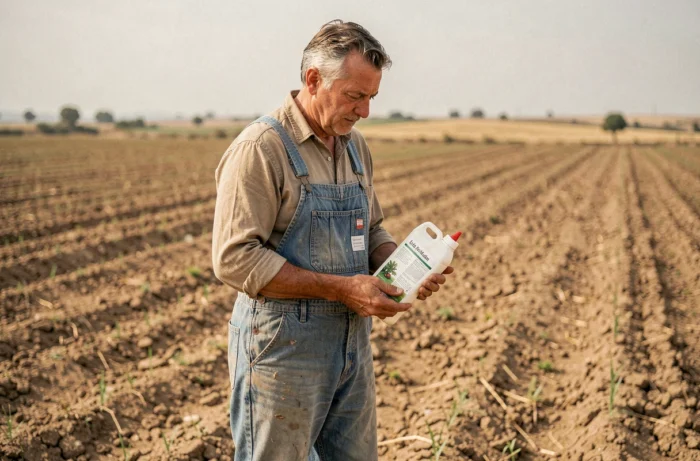
Glyphosate is a non-selective herbicide that blocks the synthesis of certain amino acids in plants, causing their death within a few days. In Spain, the active substance remains approved at the European level, with an approval extension running until December 15, 2033. This date does not mean that any product containing glyphosate can be purchased or used freely: each commercial formulation must have its own national authorization.
Spanish national register of plant protection products: the true legality criterion
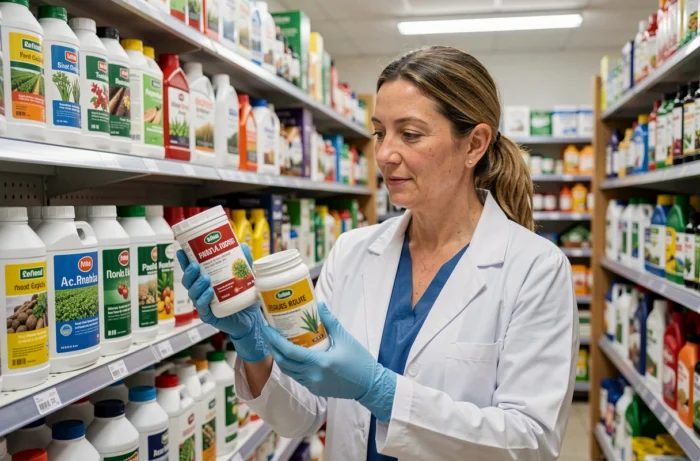
Most articles on the subject focus on points of sale or prices. However, the determining criterion is not where the canister is sold, but its registration in the official MAPA register (Ministerio de Agricultura, Pesca y Alimentación). This register lists the plant protection products authorized in Spanish territory, along with their authorization number, the specific crops and uses for which they are approved, the maximum doses, and the pre-harvest intervals.
A canister labeled “glyphosate 36%” sold in a garden center or agricultural cooperative is not automatically compliant. The Spanish label must mention the authorization number, the applicator’s protection measures, and environmental restrictions (buffer zones, distances from watercourses). Without these mentions, the product offers no regulatory guarantee.
Before any purchase, the verification consists of searching for the exact commercial name of the product in the MAPA register. Those wondering where to buy glyphosate in Spain would benefit from understanding this preliminary step, which distinguishes a compliant purchase from a blind purchase.
European authorization and national authorization: two distinct levels
The European approval of the active substance glyphosate does not equate to market authorization for a specific product. Each member state retains the competence to authorize, restrict, or refuse commercial formulations containing this substance.
In Spain, the MAPA issues these national authorizations. In France, it is ANSES that fulfills this role, and it has banned sales to individuals since 2019. The direct consequence: a glyphosate-based product legally sold in Spain has no legal value in France for an individual.
What the Spanish authorization actually covers
The national authorization sets for each product:
- The crops or areas where application is permitted (vineyards, olive trees, uncultivated areas, etc.), with maximum doses per hectare.
- The application conditions: personal protective equipment, growth stage of targeted weeds, application period.
- The environmental mitigation measures, including buffer zones intended to protect aquatic environments, the width of which varies according to the formulation and spraying equipment used.
A Spanish individual or a French tourist buying glyphosate in a garden center in Figueras or Pamplona is bound by these conditions, even for domestic use. The idea that self-service purchasing exempts one from any usage obligation is false.
Application restrictions and water protection: the often-ignored framework
The European authorization of glyphosate imposes measures to limit the contamination of surface and groundwater. These constraints are not theoretical: they appear on the label of each authorized product and engage the user’s responsibility.
Buffer zones vary by product. Some formulations require an untreated strip of several meters along ditches, watercourses, and water points. Others require the use of drift-reducing nozzles. Ignoring these prescriptions exposes one to penalties, even in Spain, where phytosanitary controls exist as part of the CAP conditionality for farmers.
For a French individual considering bringing back glyphosate, the issue arises at another level. Importing a plant protection product not authorized by ANSES into France constitutes an infringement of the Rural Code. The product may be confiscated and destroyed, and fines are provided for by French regulations.
Glyphosate and CAP conditionality: a concrete risk for farmers
Farmers receiving CAP aid are subject to conditionality checks that include compliance with phytosanitary rules. Using a product not registered in the country where the farm is located, or failing to comply with the usage conditions stated on the label, can lead to a reduction in CAP aid.
This point directly concerns French farmers in border areas who might be tempted to buy glyphosate in Spain for use on their French plots. The product must be authorized by ANSES for the relevant crop and use in France. A Spanish authorization number does not replace a French authorization number.
The label as a legal document
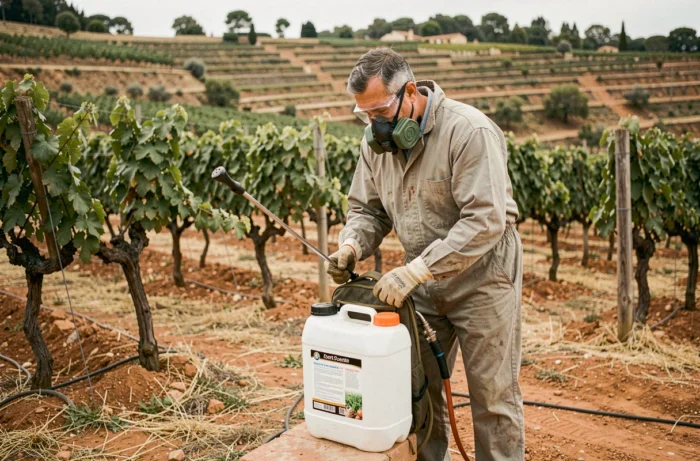
The label of a plant protection product is not just a user manual. It has regulatory value. Any use not in accordance with the label’s prescriptions (dose, crop, pre-harvest interval, protective equipment) constitutes an infringement. This principle applies in both Spain and France.
Reading the label before purchase, rather than after, allows one to verify that the product actually meets the need. A glyphosate authorized only on perennial crops cannot be used on a lawn or vegetable garden, even if the concentration of the active substance is the same.
Weeding without glyphosate: compliant methods on both sides of the border
For French individuals, the question of glyphosate in Spain often arises due to a lack of satisfactory solutions at home. Several weeding methods remain legal and accessible in France:
- Thermal weeding (flame or steam), effective on young weeds and hard surfaces like paths and patios.
- Herbicides based on pelargonic acid or acetic acid, authorized for individuals in France, with a quick contact action but no systemic effect on roots.
- Organic or mineral mulching, which limits the emergence of weeds by depriving seeds of light.
- Mechanical weeding (hoe, cultivator), suitable for small garden areas and vegetable gardens.
None of these methods match the systemic effectiveness of glyphosate on deep-rooted perennials. The choice depends on the type of surface, weed pressure, and available time. Combining mulching and mechanical weeding covers the majority of a private garden’s needs.
The regulatory framework for glyphosate in Spain remains more permissive than in France, but it is not without constraints. The active substance is approved until 2033, each commercial product follows its own authorization regime, and the application conditions stated on the label apply to all users. Bringing back a canister to France without ANSES authorization remains an infringement, regardless of the ease of purchase on the other side of the Pyrenees.