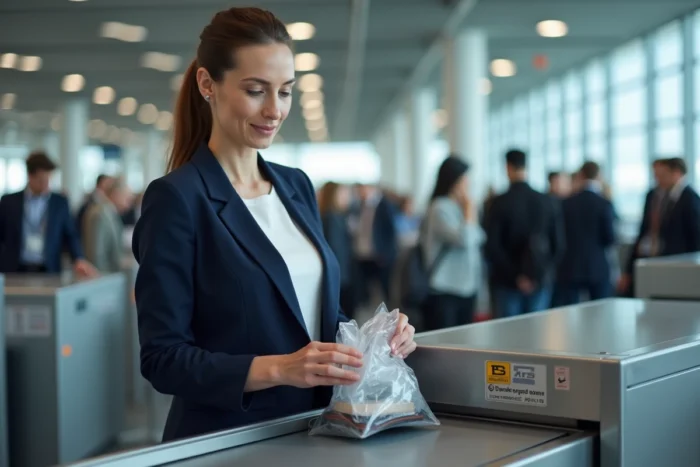
Passing through the security arch with a bundle of cash in your pocket is a situation that many travelers dread without really understanding what is at stake. Traveling with cash is legal, including on airplanes. The framework changes depending on the amount being transported, and the scanners at the airport do not fulfill the role they are often credited with.
What airport scanners really detect about cash
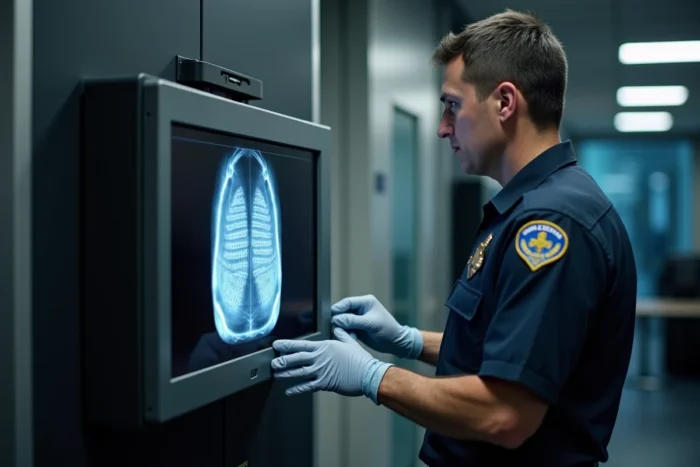
Sometimes we imagine that control machines detect banknotes as they would detect a knife or a lighter. The technical reality is different. The X-ray scanners used for luggage analyze the density and shape of objects, not their monetary nature. A thick bundle of banknotes appears on the screen as a rectangular mass of high paper density, just like a book or a stack of documents.
The security agent observing the screen is looking for weapons, explosives, sharp objects, or suspicious masses. If your cash is spread out in a wallet or pouch, it does not particularly attract attention. A compact block of several hundred banknotes, on the other hand, may trigger a manual inspection of the luggage, simply because its density is out of the ordinary.
Airport scanners are also used to detect cash in certain customs contexts, but it is important to distinguish between two control chains that operate in parallel: airport security and customs. The former looks for dangerous objects. The latter is interested in financial flows.
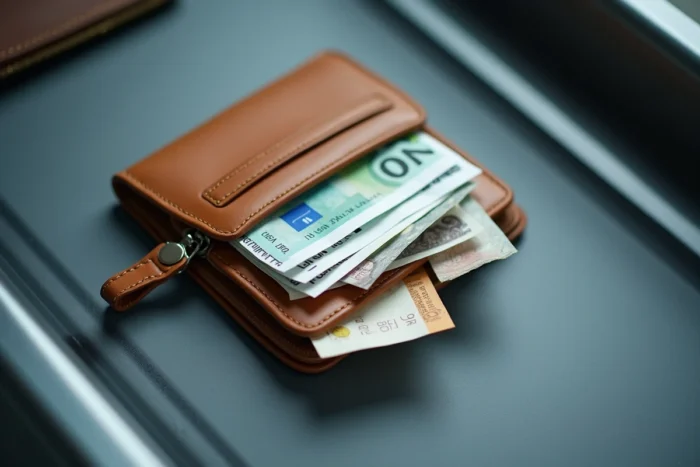
Airport security and customs: two controls, two objectives
Confusing the two is the most common mistake. When passing through the arch with your belongings on the conveyor, you are facing security. These agents have no mandate to check your cash. Their mission is limited to physical threats to flight safety.
Customs officers, on the other hand, intervene at a different time, often after landing or in dedicated areas before boarding international flights. They are the ones who can ask you to justify the source of your funds and check if you have filled out a declaration.
- Security uses X-ray scanners and metal detectors to spot weapons, explosives, and prohibited items in the cabin.
- Customs have their own tools (document checks, interrogations, sometimes specific scanners) and target suspicious financial movements.
- A security agent who notices an unusual amount can alert customs, but they will not conduct a financial check themselves.
This distinction is crucial. You can pass through security control with a significant amount without anyone batting an eye, but you can find yourself in trouble at customs due to lack of declaration.
Mandatory cash declaration: the threshold of 10,000 euros
In France and throughout the European Union, any person carrying 10,000 euros or more must declare this amount to customs. This threshold also applies to equivalents in foreign currencies, traveler’s checks, gold bars, or any other negotiable financial instrument.
The declaration is made before passing through customs, usually via a form available online or on-site. Failing to declare exposes you to penalties ranging from partial seizure of funds to fines proportional to the undeclared amount.
The case of unaccompanied shipments
One point that travel guides rarely mention: the obligation to declare extends to unaccompanied shipments. If you are sending an amount equal to or greater than 10,000 euros by mail or freight, the declaration remains mandatory. Some customs administrations, such as that of Luxembourg, specify a maximum period of 30 days to regularize after requisition. After this period, it is an offense.
In other words, splitting the money between your luggage and a separate postal shipment does not exempt you from anything. The threshold applies to all amounts transported, regardless of the mode.
Transporting cash in the cabin or in the hold: practical consequences
You can keep your cash on you, in a carry-on bag, or in checked luggage. None of these options are prohibited, but each presents different risks.
Keeping the money in a pocket or handbag means it will either go through the scanner tray or be on you at the arch. Opinions vary on this point: some travelers prefer to place the amount in the tray to avoid a pat-down, while others keep it in an inner pocket. In both cases, security agents are only interested if the shape or density intrigues them.
Placing the money in the hold carries a risk of loss or theft, as you no longer have access to your luggage during the flight. Checked luggage also goes through more powerful scanners, but the logic remains the same: they are looking for dangerous substances, not banknotes.
- In the cabin: permanent access, risk of visual inspection at the carry-on baggage scanner.
- In the hold: no access during the flight, risk of loss, automated scanner without human intervention unless an alert is triggered.
- On you: passing through the arch or body scanner, possibility of a pat-down if a dense object is detected.
Cash on the plane: what actually triggers a check
The vast majority of travelers carrying a few hundred euros encounter no problems. The situations that attract attention are specific.
A very thick bundle, poorly organized, that creates an opaque block on the scanner screen can lead to a bag being opened. Nervous behavior at customs can lead to an interrogation. And above all, failure to declare amounts over 10,000 euros remains the main trigger for sanctions.
Scanners are not designed to count your banknotes. They produce an image based on the density of the materials passed through by the X-rays. Paper money does not have a distinct radiological signature from a block of ordinary paper. What makes the difference is the volume: a few banknotes go completely unnoticed, while a brick of banknotes stands out like any dense and compact object.
The legal framework is clear, technology has its limits, and the boundary between security and customs remains the point that every traveler should master before boarding with cash.